Ms. Baldwin's
ELA & SS Classes
  • Home
  • News & Events
  • Student Expectations
  • School Supply Information
    • School Supplies & Donations
  • Homework/Agenda
    • Homework Policy
  • Online Classroom Materials
  • ELA
    • ELA Assignments >
      • Why Language Arts matter?
    • Writing in Progress >
      • Our Writing Norms
      • A good writer should . . .
      • How to be a good writer.
      • Word Choice
      • CUPS
      • Editing Marks
  • Social Studies
    • Unit #1 Geography
    • Unit #2: Early Man
    • Unit #3: Ancient Mesopotamia
    • Unit #4: Ancient Egypt
    • Unit #5: Ancient Israel
    • Unit #6: Ancient India
    • Unit #7: Ancient China
    • Unit #8: Ancient Greece
    • Unit #9: Ancient Rome
  • Technology
    • Hour of Code & T.E.D. Talks
    • Genius Hour
  • Helpful Links
    • Student Links
    • Parental Links
  • SBAC
  • Contact Information

Ancient China

Picture

Picture

http://www.socialstudiescms.com/ancient-china


​Ancient China https://sites.google.com/site/1ancientcivilizationsforkids/ancient-china
 
http://china.mrdonn.org/index.html
 
http://www.kidspast.com/world-history/0040-chinese-civilization.php
​
Confucius 
http://ancienthistory.mrdonn.org/Confucius.html
 
http://www.philosophyslam.org/confucius.html
 
http://www.kidspast.com/world-history/0139-confucianism.php
 
http://www.ducksters.com/history/china/confucius.php
 
http://www.uri.org/kids/other_conf.htm


Essential Questions

Vocabulary

  • Describe the geography of China and tell how the geography influenced how people lived in ancient China.

  • What can the meanings of some characters in the Chinese language tell us about gender roles in ancient Chinese society?

  • Describe the characteristics of the art produced during the time of the Shang Dynasty.

  • Identify some important elements of the Shang religion and explain how religion in the time of the Shang dynasty was different from religions today like Judaism, Christianity, and Islam.

  • What is a dynasty and why is the idea of a “dynastic cycle” important to understand when you are studying ancient Chinese dynasties?

  • What sort of “message” was Confucius trying to send?

  • Would you want the United States to adopt Legalism? Why or why not?

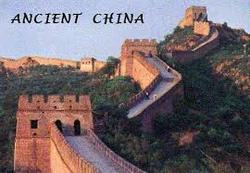
  • Was the construction of the Great Wall of China a good or bad decision for China? Support your answer with details.

  • Compare and contrast Daoism with the ideas of Confucianism.

  • Describe travel conditions along the Silk Road.

  • How did the Silk Road impact China and what effect did it have on the rest of the world?

  • Which of the Chinese inventions from the Han Dynasty and from the time of other Chinese dynasties do you think were the most important?

  • What was the greatest accomplishment of the Sui Dynasty?

  • Describe the most important cultural contribution of the Tang Dynasty.

  • Describe the cultural practice that the Sung Dynasty is best known for.

  • Why were the Mongols so successful in establishing an empire?

  • What sort of pressures eventually led to the end of the last of the Chinese Dynasties?

  • Doaism: religion that teaches people to give up earthly desires in favor of nature.

  • Shi Huangdi: first emperor of China.

  • Silk Road: 4,000 mile trade route between China and Europe. Social Class: three levels of society-peasants, nobles, king

  • pictographs: characters that stand for objects in writing.

  • dynasty: line of rulers that belong to the same family.

  • Legalism: obeying rulers out of fear.

  • Oracle Bones: used to predict that future in the Shang dynasty.

  • Confucianism: philsophy that teaches responsibility and moral behavior.

  • Filial Piety: children must respect their parents

  • North China Plain: fertile land for farming. Where China started. accupuncture: method of relieving the pain by sticking tiny needles in the skin.

  • Great Wall of China: built for defensive purposes.


Quotation

Did You Know?

"Choose a job you love, and you will never have to work a day in your life."  

"I hear and I forget. I see and I remember. I do and I understand."

~Confucius

Confucius spent most of his life traveling throughout China, teaching about the importance of duty, ritual, and virtue. He taught that a ruler must set an example to inspire people to strive for a moral life. Years after he died, students assembled his teachings into a book, the Analects, and a new school of thought developed—Confucianism. This philosophy deeply influenced China throughout most of its history.


ENDURING UNDERSTANDINGS STUDENTS WILL UNDERSTAND:

  • The great minds of the past have developed ideas that can enrich our lives and our world.

  • Over the course of history, the same country can swing from tremendously powerful to dangerously weak and back again.

  • There is no such thing as a perfect government.

  • Ancient China is 20 percent larger than the United States.

  • It is one of the world's oldest continuous civilization.

  • It is also home to the largest population on Earth.

  • The first calendar, ice cream, kites, soccer, mechanical clock, paper, the compass, explosive powder, fireworks, silk, porcelain, printing, the wheel and toilet paper all had their start in China.

  • There are Twelve animals in the Chinese Zodiac.

  • A full Zodiac is 12 years.

  • When you write your name in Chinese you always begin with your family's name then your first name.

  • The Chinese dragon is not evil, it is a symbol of prosperity, wisdom and power.

  • The color red symbolizes happiness in China.


Teacher Resources

China River Valley Civilization PowerPoint
entions an Technolog
Using Primary Sources - Inventions and Technology of the Ancient Chines by Kathy Simpson, Carlisle,MassachussettsI ventions and Technology of the Ancient Chinese by Kathy Simpson, Carlisle, Massachusetts 


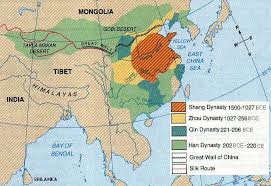
Geography of China

In this lesson, you will learn about the geography of China.

Geographic Features of China...

6.30 Identify and locate on a map the geographical features of China, including the Huang He (Yellow) River, Plateau of Tibet, and Gobi Desert.

STORY HIGHLIGHTS

"Chinese civilization originated in various regional centers along both the Yellow River and the Yangtze River valleys in the Neolithic era, but the Yellow River is said to be the cradle of Chinese civilization. With thousands of years of continuous history, China is one of the worlds oldest civilizations. The written history of China can be found as early as the Shang Dynasty (c. 1700--1046 BC)"

  • Haiku Deck:  Five Geographical Features of China

  • Purpose Games:  Geographical Features of China Interactive Game

2000 YEARS OF CHINESE HISTORY! 
  • The Middle Kingdom

Contributions to the Wold

In this lesson, you will learn about the many innovations and aspects of ancient China, ranging from cultural elements such as religion and kung fu to inventions including the compass, gunpowder, and noodles.

Ancient China:  From Dynasty to Destiny

In this lesson, you will learn about the building of the Great Wall of China during the Shang Dynasty and the development of a bureaucracy during the Han Dynasty.

Chinese Dynasties

6.31 Locate and describe the origins of Chinese civilization in the Huang-He Valley during the era of the Shang Dynasty.STORY HIGHLIGHTS

China Dynasty Map:  Follow the timeline showing all of the Chinese dynasties since 1000 BC.

  • Asia for Educators:  The Shang Dynasty


INTERACTIVE SITES
  • Brain Pop Ancient China

  • Researching Ancient China

  • Ancient Civilizations for Kids​

History of China

In this lesson, you will learn about the history of China.

Key Links on Ancient China

Ancient China
Ancient China for Kids

Dynasties of Ancient China
Review Game Zones for China's Early Dynasties
Asia for Educators
China
The Middle Kingdom
Shang Dynasty - China's First Recorded History
Han Dynasty - Cultural Heights


​

Powered by Create your own unique website with customizable templates.